Search
× Search

Our Clinics

Serving Oklahoma since 1925, the Oklahoma Allergy & Asthma Clinic’s main headquarters office is located at the Oklahoma Health Center, across the street from OU Medical Center. We have satellite clinics in Norman, Edmond, Midwest City, and Yukon. We have free parking at all of our locations.

Our Clinics

Since 1925, the Oklahoma Allergy & Asthma Clinic (OAAC) has been a leader in innovative allergy, pollen allergy, food allergy, skin allergy, and asthma treatments. OAAC is one of the largest allergy and asthma medical practices in the Southwest, with eight board-certified allergists, a doctor of nursing, and three nurse practitioners.

The Edmond satellite clinic opened in 2013 after previously being located in a rented office space. The clinic is conveniently located in southeast Edmond at Boulevard and between 33rd and Memorial Road at 3560 S Boulevard Street, Suite 150.

OAAC opened its first satellite office in 1983 in Norman. A new clinic building was constructed and opened in 2017. The building is 6,660 square feet, with 4,600 of that dedicated to the OAAC practice. The Norman clinic is conveniently located at 3580 R.C. Luttrell Drive off the Healthplex Parkway in Medical Park West, right off I-35 and...
OAAC’s newest satellite clinic, opened in 2019, is located in the western side of the metro, Yukon - the growing metropolis with a small hometown feel. The clinic is just east of Target on Health Center Parkway.  The 3,000 square foot building is similar to the clinic in Norman and features Oklahoma artist Lindy Jerlow’s work...

Services

image
Asthma

Asthma is a chronic condition in which the lining of the airways or bronchial tubes become inflamed and irritated.

image
Allergies

Allergies (hayfever) are caused by the immune system reacting to substances (or allergens) that would typically not trigger a reaction.

image
Food Allergies

Food allergies occur with the body has an abnormal immune response from exposure to a food.

image
Mold Allergies

Mold spores are released throughout the year. Molds live everywhere, and upsetting a mold source can send spores into the air and be possibly inhaled into the lungs.


image
Pollen Allergies

Pollen is one of the most common triggers of seasonal allergies. It is also called seasonal allergic rhinitis or hay fever.


image
Allergic Rhinitis

Allergic rhinitis causes misery for many during Oklahoma’s long allergy seasons. Rhinitis means "inflammation of the nose."


Recent News

Study shows limited benefits of elimination diets for children with atopic dermatitis
SuperUser Account
/ Categories: News

Study shows limited benefits of elimination diets for children with atopic dermatitis

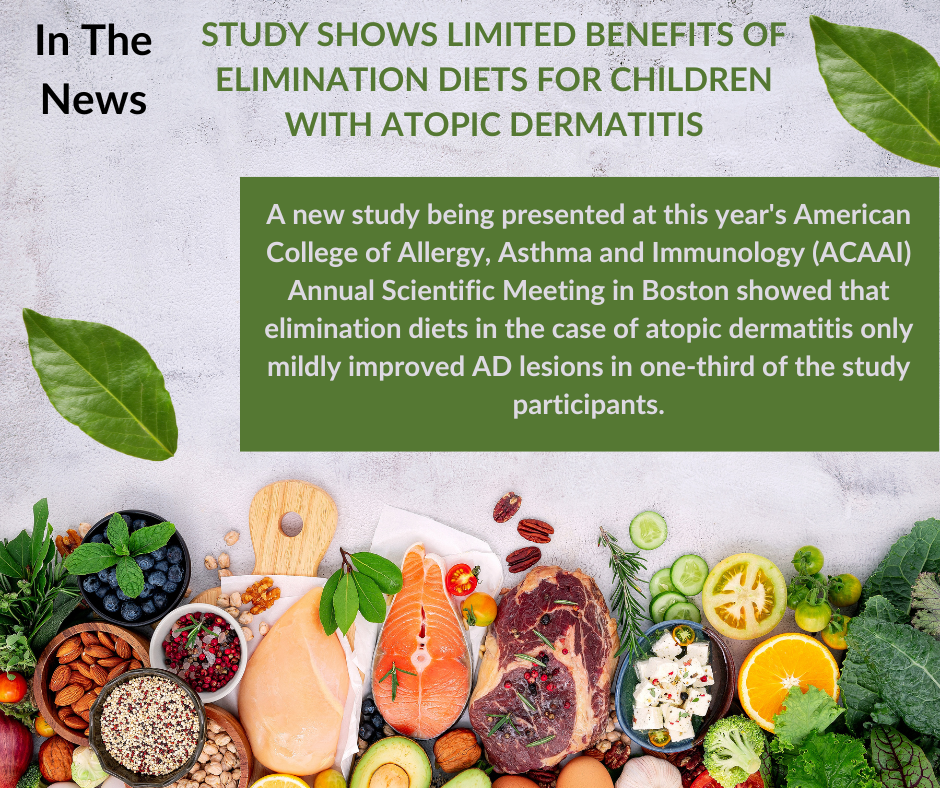
Parents of children with atopic dermatitis (AD, also called eczema) know that the allergic condition can mean a heightened risk of developing food allergies. The desire to prevent food allergies causes some parents to consider elimination diets, cutting out certain foods from their child’s diet. A new study being presented at this year’s American College of Allergy, Asthma and Immunology (ACAAI) Annual Scientific Meeting in Boston showed that elimination diets in the case of atopic dermatitis only mildly improved AD lesions in one-third of the study participants.

Elimination diets aren’t recommended as a treatment for AD, according to guidelines from major allergy organizations. For our study, parents of infants and children with AD completed a survey in a number of sites in a single health care system including the emergency department, allergy, dermatology and general pediatrics clinic to gauge their perceptions of the effects of elimination diets on development of food allergies.” –Nadia Makkoukdji, MD, pediatric resident, lead author of the study

298 parents completed the survey. 42% reported that certain foods exacerbate their child’s eczema. The foods most frequently identified as triggers were milk (32%), tree nuts/seeds/peanuts (16%,) and eggs (11%).

Among those who identified food triggers:

  • 19% changed their baby’s formula
  • 20% eliminated certain foods from their diet while breastfeeding and
  • 23% completely removed the suspected foods from their child’s diet.

Regarding the elimination diet’s effectiveness, 38% observed no improvement in AD, 35% reported 25% improvement, and 9% noted complete resolution. Additionally, 79% of responders reintroduced the eliminated foods without recurrence of eczema symptoms. The authors concluded that parents’ understanding of AD and its dietary links significantly influenced their children’s diets.

Source: American College of Allergy, Asthma, and Immunology

The post Study shows limited benefits of elimination diets for children with atopic dermatitis appeared first on Oklahoma Allergy and Asthma Clinic.

Previous Article CDC approves monovalent COVID-19 boosters for adults
Next Article Study finds connection between air pollution and childhood peanut allergies
Print
1166
Terms Of UsePrivacy StatementCopyright 2026 by Oklahoma Allergy and Asthma Clinic
Back To Top