OKC named 4th most challenging city for spring allergies
3-15-2023 – Today, the Asthma and Allergy Foundation of America (AAFA) released its annual Allergy Capitals report for 2023. The report identifies the most challenging cities for pollen allergies in the 100 most populated metropolitan areas in the continental United States. Cities are ranked based on tree, grass, and weed pollen scores, over-the-counter allergy medicine use, and availability of board-certified allergists/immunologists.
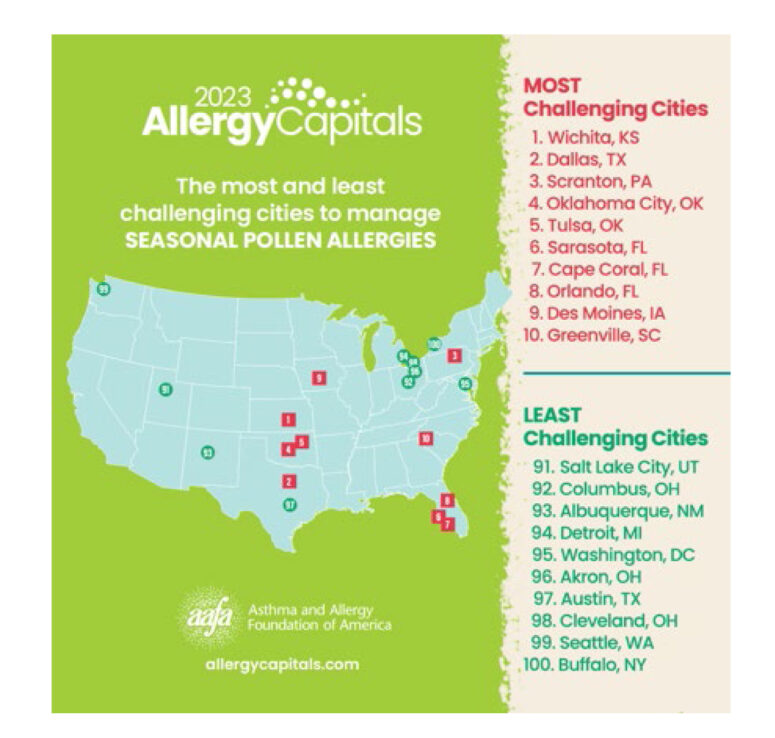
Oklahoma City was ranked fourth and Tulsa was fifth. Wichita, Kansas, took the top spot based on its high tree and grass pollen scores, higher-than-average use of allergy medicines, and limited number of allergy/immunology specialists per patient.
The top 20 Allergy Capitals for 2023 are 1. Wichita, KS; 2. Dallas, TX; 3. Scranton, PA; 4. Oklahoma City, OK; 5. Tulsa, OK; 6. Sarasota, FL; 7. Cape Coral, FL; 8. Orlando, FL; 9. Des Moines, IA and 10. Greenville, SC. Oklahoma was sixth in 2022 while Tulsa was 21st.
AAFA began identifying annual Allergy Capitals 20 years ago in 2003. Since that first report, pollen counts have worsened. This year’s report once again highlights the significant impact that climate change has on public health – specifically, for people with pollen allergies. Rising temperatures result in longer growing seasons, leading to higher pollen concentrations in many areas of the country.
“We are experiencing longer and more intense allergy seasons because of climate change. For people with asthma, allergies can trigger an asthma attack,” says Kenneth Mendez, CEO and president of AAFA. “About 81 million people in the U.S. have seasonal allergic rhinitis, which is most often caused by pollen allergies. If we don’t take immediate action on the climate crisis, pollen production will only intensify. This means more allergy and asthma attacks and additional strain on our health systems.”
The National Climate Assessment from the U.S. Global Change Research Program confirms that climate change is a major threat to public health. Longer and more intense pollen seasons caused by climate change particularly impact people with allergies and asthma. From 1990-2018, the plant-growing season extended an average of 20 days and produces about 21 percent more pollen, putting people with pollen allergies at risk of more symptoms for longer periods. Allergies can also trigger asthma episodes or attacks. Around 60-80 percent of the nearly 26 million people in the U.S. with asthma have allergic asthma.
“As pollen counts spike, we often see spikes in emergency room visits for asthma,” Mendez says. “Around 3,600 people per year die from asthma, so it is important to address and manage asthma and allergy triggers where you live.”
Black, Hispanic, and Indigenous populations bear the disproportionate burden of air pollution, asthma, allergies, and climate change. This is the result of a long history of discriminatory housing and environmental policies in the U.S. that have pushed people of color to live in undesirable neighborhoods with greater environmental and social risks. As a result of systemic racism in U.S. policies, governance, and culture, racial and ethnic minority populations are more vulnerable to the health impacts of climate change.
“AAFA’s Allergy Capitals report serves as a national call-to-action on climate change due to its impacts on individual and community health,” says Melanie Carver, chief mission officer of AAFA. “While there are steps individuals can take to manage their symptoms, it is imperative for communities to build their climate resiliency, improve their city planning, and take action on health disparities impacting higher risk populations.”
For people who are impacted by pollen allergies, there are options available to prevent or treat allergy symptoms. Treatment options include over-the-counter or prescription allergy medicines. Medications are most effective when started before a person’s allergy season begins.
“The Oklahoma City area has pollen all four seasons of the year, so many allergy sufferers don’t get much of a break,” said Bret Haymore, MD, board-certified allergist with the Oklahoma Allergy & Asthma Clinic.
Haymore recommends seeing an allergist who can find out what your allergy triggers are and make a treatment plan to best help manage them.
For more information, visit the OAAC website at www.oklahomaallergy.com to view the addresses for all Oklahoma Allergy and Asthma Clinic locations. To make an initial appointment or to request more information, please call (405) 235-0040.
The post OKC named 4th most challenging city for spring allergies appeared first on Oklahoma Allergy and Asthma Clinic.
780