Search
× Search

Eczema

Eczema is frequently called atopic dermatitis because it was noted to occur in individuals with allergic symptoms, e.g., allergic rhinitis (hay fever) and asthma. The term atopic simply means allergic. Even though eczema was considered to be an allergic problem, allergy seems to be less likely as our understanding of the disease increases. Physicians know that eczema is a very complex disease and contains allergic as well as non-allergic elements in different individuals. As a result, the treatment of every individual may vary.

While the causes of eczema continue to be investigated, certain things are known about the disease. The skin is much more easily irritated than normal skin. Dryness of the skin is a primary component and results in significant itching. Eczema is known as “the itch that rashes”. Itching is made worse by irritants on the skin. Winter months are particularly bothersome because of the dry winter air. Flares in the summer months can occur after exercise because sweat is a significant irritant. Citrus or some vegetables, e.g., tomato, can act as a primary irritant when they touch the skin. Stress in some individuals can affect the skin. While emotional factors may play a role in flaring eczema, they are not considered a primary source of causing the onset of eczema, if it is not already present.

Eczema occurs in about 3% of the population. In about 80% of those individuals, the onset occurs in the first year of life. One-half are free of disease by age 2 years, about one-fourth by the end of adolescence, and the remaining one-fourth will continue to have eczema into adult life. Some individuals do not have the onset of symptoms until adolescence or adulthood.

Treatment is multifaceted and includes lifestyle modification as well as various types of medication. A portion of treatment will be listed in the accompanying tables. Adequate attention to clothing, diet manipulation, and attention to the emotional well-being of the affected patient are very important. It is preferable for a patient with eczema to wear clothing which will not irritate the skin; soft cotton material would be best. The room temperature should be kept moderate with controlled humidity (between 35-50%). Overheating and perspiration should be avoided.

Some investigators believe there is a genetic tendency for eczema with approximately 50% of eczema patients ultimately developing allergic rhinitis and/or asthma. This is compared to about 20% without the presence of eczema. While allergy skin testing and allergy injection treatment are usually helpful in cases of allergic rhinitis and/or asthma, it is generally agreed that this is often not the case with eczema. In some individuals, starting allergy shots for allergic rhinitis and/or asthma may actually result in significant flaring of the eczema.

Prevention

  • Trim fingernails short
  • Cotton gloves at night if needed to decrease scratching
  • Clothing should be double rinsed after washing to remove all residual detergent (irritants)
  • Avoid excessive room temperatures
  • Wear light, non-occlusive clothing (e.g., cotton instead of polyester)
  • Keep the bedroom moderate (cool) and avoid excessive bed clothing
  • Allergen contact or ingestion avoidance (e.g., foods, pets, dust mite) can reduce stimulation of the skin

Treatment

  • Bathing for moisturization, e.g., soaking in tepid water for 30-45 minutes at least once daily and if possible 2-3 times.
  • Within 2 minutes after getting out of the tub, a lubricating cream or ointment should be applied to help hold the moisture in the skin. Examples include Aquaphor, Curel, Moisturel, Eucerin, Keri, Lubriderm, Acid Mantle, Unibase, Vanicream, petrolatum, and chilled Noxzema,etc. Newer medications include Triceram/Certopic, Impruv, Mimyx, Nourica Repair, Cerave, Atopiclair, and Hylira. Some of the newer medications are by prescription only. None of the medications in the above list contain steroids.
  • In general, lotions should be avoided since they contain alcohol which may sting and provide limited moisture.
  • If marked irritation or weeping areas are present, wet wraps with a drying solution (e.g., Burrow’s solution, one tablet mixed in one quart of water is available by prescription) will avoid the stinging or burning sensation that can occur with bathing.
  • Addition of oil or similar substances to the bath water generally has little effect on increasing moisturization.
  • Pat dry with a soft towel; do not “rub” dry since this will remove natural, protective oils from the skin.
  • Showers do not add moisture to the skin and actually remove the protective oils from the skin resulting in increased dryness.
  • Topical steroids are the mainstay of therapy for more severe eczema. Ointments or creams are generally used.
  • Nonsteroidal medications that help the immune system in the skin may be necessary either in addition to or in place of topical steroids if the topical steroids are not adequate for relief. Examples of the nonsteroidal medications are Elidel and Protopic.
  • Antibiotics, topical and/or oral, may be needed if the lesions become infected. An alternative to antibiotics is the use of Clorox baths. One-quarter to one-half cup of Clorox in a full bath provides antibacterial activity that will treat all known bacterial infections. No resistant bacteria to Clorox are known.

Recent News

SuperUser Account
/ Categories: News

OKC named 4th most challenging city for spring allergies

3-15-2023 – Today, the Asthma and Allergy Foundation of America (AAFA) released its annual Allergy Capitals™ report for 2023. The report identifies the most challenging cities for pollen allergies in the 100 most populated metropolitan areas in the continental United States. Cities are ranked based on tree, grass, and weed pollen scores, over-the-counter allergy medicine use, and availability of board-certified allergists/immunologists.

Oklahoma City was ranked fourth and Tulsa was fifth. Wichita, Kansas, took the top spot based on its high tree and grass pollen scores, higher-than-average use of allergy medicines, and limited number of allergy/immunology specialists per patient.

The top 20 Allergy Capitals for 2023 are 1. Wichita, KS; 2. Dallas, TX; 3. Scranton, PA; 4. Oklahoma City, OK; 5. Tulsa, OK; 6. Sarasota, FL; 7. Cape Coral, FL; 8. Orlando, FL; 9. Des Moines, IA and 10. Greenville, SC.  Oklahoma was sixth in 2022 while Tulsa was 21st.

AAFA began identifying annual Allergy Capitals 20 years ago in 2003. Since that first report, pollen counts have worsened. This year’s report once again highlights the significant impact that climate change has on public health – specifically, for people with pollen allergies. Rising temperatures result in longer growing seasons, leading to higher pollen concentrations in many areas of the country.

“We are experiencing longer and more intense allergy seasons because of climate change. For people with asthma, allergies can trigger an asthma attack,” says Kenneth Mendez, CEO and president of AAFA. “About 81 million people in the U.S. have seasonal allergic rhinitis, which is most often caused by pollen allergies. If we don’t take immediate action on the climate crisis, pollen production will only intensify. This means more allergy and asthma attacks and additional strain on our health systems.”

The National Climate Assessment from the U.S. Global Change Research Program confirms that climate change is a major threat to public health. Longer and more intense pollen seasons caused by climate change particularly impact people with allergies and asthma. From 1990-2018, the plant-growing season extended an average of 20 days and produces about 21 percent more pollen, putting people with pollen allergies at risk of more symptoms for longer periods. Allergies can also trigger asthma episodes or attacks. Around 60-80 percent of the nearly 26 million people in the U.S. with asthma have allergic asthma.

“As pollen counts spike, we often see spikes in emergency room visits for asthma,” Mendez says. “Around 3,600 people per year die from asthma, so it is important to address and manage asthma and allergy triggers where you live.”

Black, Hispanic, and Indigenous populations bear the disproportionate burden of air pollution, asthma, allergies, and climate change. This is the result of a long history of discriminatory housing and environmental policies in the U.S. that have pushed people of color to live in undesirable neighborhoods with greater environmental and social risks. As a result of systemic racism in U.S. policies, governance, and culture, racial and ethnic minority populations are more vulnerable to the health impacts of climate change.

“AAFA’s Allergy Capitals™ report serves as a national call-to-action on climate change due to its impacts on individual and community health,” says Melanie Carver, chief mission officer of AAFA. “While there are steps individuals can take to manage their symptoms, it is imperative for communities to build their climate resiliency, improve their city planning, and take action on health disparities impacting higher risk populations.”

For people who are impacted by pollen allergies, there are options available to prevent or treat allergy symptoms. Treatment options include over-the-counter or prescription allergy medicines. Medications are most effective when started before a person’s allergy season begins.

“The Oklahoma City area has pollen all four seasons of the year, so many allergy sufferers don’t get much of a break,” said Bret Haymore, MD, board-certified allergist with the Oklahoma Allergy & Asthma Clinic.

Haymore recommends seeing an allergist who can find out what your allergy triggers are and make a treatment plan to best help manage them.

For more information, visit the OAAC website at www.oklahomaallergy.com to view the addresses for all Oklahoma Allergy and Asthma Clinic locations.  To make an initial appointment or to request more information, please call (405) 235-0040.
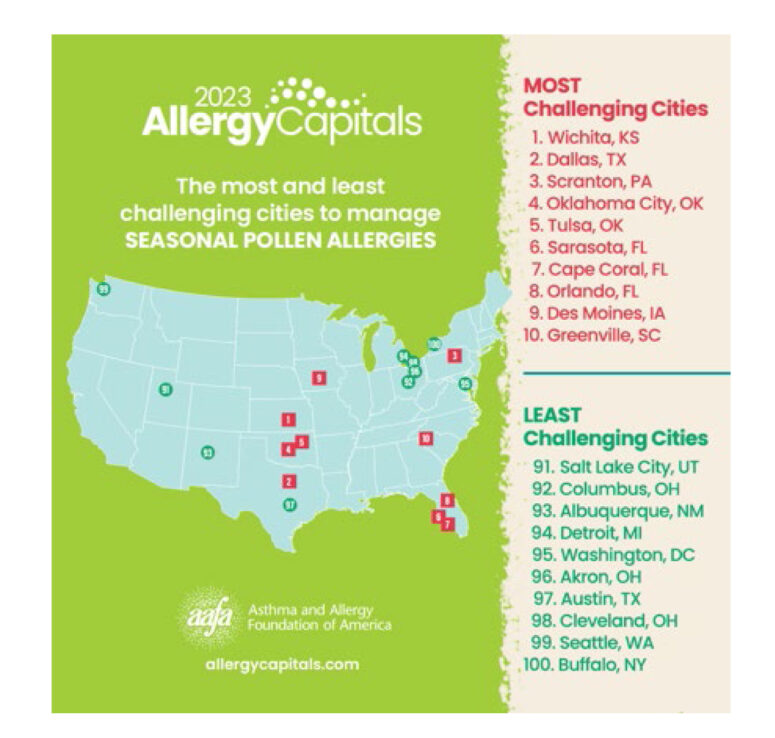
Spring Allergy Chart


The post OKC named 4th most challenging city for spring allergies appeared first on Oklahoma Allergy and Asthma Clinic.

Previous Article Dr. Claire Atkinson passes allergy and immunology board exam
Next Article OAAC does not Renew Lease for Midwest City Satellite Clinic
Print
104
Terms Of UsePrivacy StatementCopyright 2026 by Oklahoma Allergy and Asthma Clinic
Back To Top