Search
× Search

Nickel Allergy

Nickel allergy is a very common form of Allergic Contact Dermatitis (ACD). A rash develops after contact with nickel and may have the following characteristic(s): redness, itching, swelling, hives and/or cracks.

Nickel Allergy

Piercing is a major cause of nickel allergy. When the skin is injured, prolonged contact with nickel causes an allergic reaction. Nickel salts from the jewelry penetrate the skin and cause sensitization. Once an individual is sensitized to nickel, symptoms will appear after contact with nickel.

Nickel allergy is considered a delayed Type IV allergy meaning an allergic reaction may occur up to 48 hours after nickel contact.

Allergy relief

For immediate relief, your doctor may recommend a steroid cream to help reduce inflammation and redness. Nickel allergy rashes usually clear once contact with nickel is stopped. It is important to identify the source of nickel and avoid it.

How to avoid nickel

The key to avoiding nickel is to identify it before your skin does.

All metal items suspected of containing nickel may be tested with a dimethyl glyoxime test called Nickel Alert. Nickel alert quickly, safely, and easily tests jewelry and other metal items for the presence of nickel.

Where nickel is found

Nickel is frequently found in metal and metal objects including gold because it is inexpensive, durable, and lustrous.

Often when it is difficult to identify the nickel source because a rash might not appear for two days. It is critical to test all metal items since there are often multiple sources of exposure.

Commons items that may contain nickel:

  • Earrings
  • Necklaces
  • Rings
  • Bracelets
  • Costume and heirloom jewelry
  • Buttons and snaps
  • Belt buckles
  • Zippers
  • Fasteners
  • Hand tools and scissors
  • Keys and coins
  • Eyeglass frames
  • Watches and bands
  • Gold-white and yellow, especially 10 and 14 ct
  • Brass or chrome fixtures
  • Kitchen utensils—silverware
  • Bra hooks
  • Suspender clips
  • Hair pins
  • Handbags / clutches
  • Cigarette lighters
  • Jean studs
  • Razors
  • Pocket knives
  • Pens
  • Lipstick holders
  • Powder compacts
  • "Hypoallergenic and "Nickel-free" jewelry

Nickel allergy Facts

  • The most common sites for nickel allergy are earlobes, neck, and wrist where metal touches the skin. In children, one of the most common signs of nickel allergy is a rash on the central abdomen from snaps/buttons.
  • Nickel allergy can develop at any age and often last a lifetime.
  • Nickel allergy is the second most common form of allergic contact dermatitis after poison ivy, oak and sumac.
  • 15% of the women in the U.S. are nickel allergic.
  • There is no cure for nickel allergy.

Nickel-free and hypoallergenic jewelry

There are no government standards or regulations for using the terms "nickel-free" or "hypoallergenic".

Jewelry labeled "nickel-free" or "hypoallergenic" often refers only to the plating. The base metal may contain nickel. Once the plating wears thin, even microscopically, nickel salts will come in contact with your skin and symptoms can occur.

Expensive jewelry may contain nickel in the base metal.

Test your jewelry regularly, even the "safe" items, using the dimethyl glyoxime test – Nickel Alert.

Metals that often contain nickel

  • Gold-white and yellow
  • Silver, sterling silver, silver plate
  • Palladium
  • Chrome (or Chromate)
  • Cobalt

Suitable replacements for nickel

  • Aluminum
  • Titanium
  • Platinum
  • Plastic
  • Wood

When avoidance of nickel is not possible

Avoiding nickel is ideal, but not always possible. When avoidance of nickel is not possible, coat the metal that contacts your skin (jean studs, eyeglass frames, etc.) with a clear coating. Avoid generic nail polishes; they often contain toluene, formaldehyde and dibutyl phthalate which can lead to further sensitization for nickel allergic individuals. Use Nickel Guard as a safe alternative. Also, if possible, wear protective clothing (gloves, long sleeves, etc.) for larger areas.

Additional considerations

  • Weather: In summer, perspiration aids the transfer of nickel salts to the skin, increasing symptoms.
  • Diet: Severely allergic individuals may choose to avoid foods which are rich in nickel. Dietary intake of some foods has been shown to aggravate dermatitis, especially hand dermatitis. Your doctor may instruct you to avoid some foods which typically contain higher amounts of nickel, including asparagus, chocolate, peanuts, beans, peas, rhubarb, cabbage, oysters, spinach, herring, tea, mushrooms, whole meal flour, pears, sprouts, corn, raisins, onions, tomatoes, and baking powder.
  • Medical: Tell your physician that your are nickel allergic. Verify all dental appliances and surgical implants are nickel-free prior to implantation.
  • Work: For specific occupational sources of nickel, visit www.athenaallergy.com

Easily avoid nickel with Nickel Solution featuring Nickel Alert and Nickel guard.

You may order Nickel solution via:
Web: www.nickelsolution.com
Phone: (704) 947-1917
FAX: (857) 588-8765
Mail: PO Box 1294
Huntersville, NC 28070

Recent News

SuperUser Account
/ Categories: News

OKC named 4th most challenging city for spring allergies

3-15-2023 – Today, the Asthma and Allergy Foundation of America (AAFA) released its annual Allergy Capitals™ report for 2023. The report identifies the most challenging cities for pollen allergies in the 100 most populated metropolitan areas in the continental United States. Cities are ranked based on tree, grass, and weed pollen scores, over-the-counter allergy medicine use, and availability of board-certified allergists/immunologists.

Oklahoma City was ranked fourth and Tulsa was fifth. Wichita, Kansas, took the top spot based on its high tree and grass pollen scores, higher-than-average use of allergy medicines, and limited number of allergy/immunology specialists per patient.

The top 20 Allergy Capitals for 2023 are 1. Wichita, KS; 2. Dallas, TX; 3. Scranton, PA; 4. Oklahoma City, OK; 5. Tulsa, OK; 6. Sarasota, FL; 7. Cape Coral, FL; 8. Orlando, FL; 9. Des Moines, IA and 10. Greenville, SC.  Oklahoma was sixth in 2022 while Tulsa was 21st.

AAFA began identifying annual Allergy Capitals 20 years ago in 2003. Since that first report, pollen counts have worsened. This year’s report once again highlights the significant impact that climate change has on public health – specifically, for people with pollen allergies. Rising temperatures result in longer growing seasons, leading to higher pollen concentrations in many areas of the country.

“We are experiencing longer and more intense allergy seasons because of climate change. For people with asthma, allergies can trigger an asthma attack,” says Kenneth Mendez, CEO and president of AAFA. “About 81 million people in the U.S. have seasonal allergic rhinitis, which is most often caused by pollen allergies. If we don’t take immediate action on the climate crisis, pollen production will only intensify. This means more allergy and asthma attacks and additional strain on our health systems.”

The National Climate Assessment from the U.S. Global Change Research Program confirms that climate change is a major threat to public health. Longer and more intense pollen seasons caused by climate change particularly impact people with allergies and asthma. From 1990-2018, the plant-growing season extended an average of 20 days and produces about 21 percent more pollen, putting people with pollen allergies at risk of more symptoms for longer periods. Allergies can also trigger asthma episodes or attacks. Around 60-80 percent of the nearly 26 million people in the U.S. with asthma have allergic asthma.

“As pollen counts spike, we often see spikes in emergency room visits for asthma,” Mendez says. “Around 3,600 people per year die from asthma, so it is important to address and manage asthma and allergy triggers where you live.”

Black, Hispanic, and Indigenous populations bear the disproportionate burden of air pollution, asthma, allergies, and climate change. This is the result of a long history of discriminatory housing and environmental policies in the U.S. that have pushed people of color to live in undesirable neighborhoods with greater environmental and social risks. As a result of systemic racism in U.S. policies, governance, and culture, racial and ethnic minority populations are more vulnerable to the health impacts of climate change.

“AAFA’s Allergy Capitals™ report serves as a national call-to-action on climate change due to its impacts on individual and community health,” says Melanie Carver, chief mission officer of AAFA. “While there are steps individuals can take to manage their symptoms, it is imperative for communities to build their climate resiliency, improve their city planning, and take action on health disparities impacting higher risk populations.”

For people who are impacted by pollen allergies, there are options available to prevent or treat allergy symptoms. Treatment options include over-the-counter or prescription allergy medicines. Medications are most effective when started before a person’s allergy season begins.

“The Oklahoma City area has pollen all four seasons of the year, so many allergy sufferers don’t get much of a break,” said Bret Haymore, MD, board-certified allergist with the Oklahoma Allergy & Asthma Clinic.

Haymore recommends seeing an allergist who can find out what your allergy triggers are and make a treatment plan to best help manage them.

For more information, visit the OAAC website at www.oklahomaallergy.com to view the addresses for all Oklahoma Allergy and Asthma Clinic locations.  To make an initial appointment or to request more information, please call (405) 235-0040.
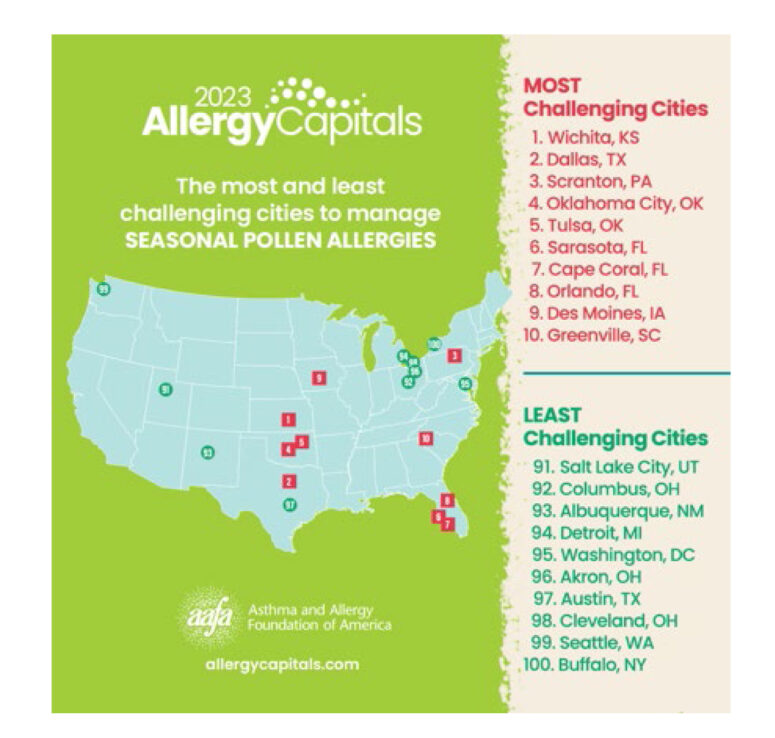
Spring Allergy Chart


The post OKC named 4th most challenging city for spring allergies appeared first on Oklahoma Allergy and Asthma Clinic.

Previous Article Dr. Claire Atkinson passes allergy and immunology board exam
Next Article OAAC does not Renew Lease for Midwest City Satellite Clinic
Print
212
Terms Of UsePrivacy StatementCopyright 2026 by Oklahoma Allergy and Asthma Clinic
Back To Top