
Summer Camps and Food Allergies: How to Prepare and Keep Your Camper Safe
Camp is one of the best parts of childhood — campfires, canoeing, new friends and a little independence. Every child deserves that experience, and kids with food allergies are no exception. It just takes a bit more planning. The good news is that with the right preparation and a strong partnership between you, your child, your allergist and the camp staff, a food-allergic camper can have a safe and genuinely fun summer.
Whether your child is headed to a day camp down the road or a sleepaway camp for a week, here are some tips for Oklahoma Allergy & Asthma Clinic to help you prepare, reduce the risk of an allergic reaction, and be ready if one happens.
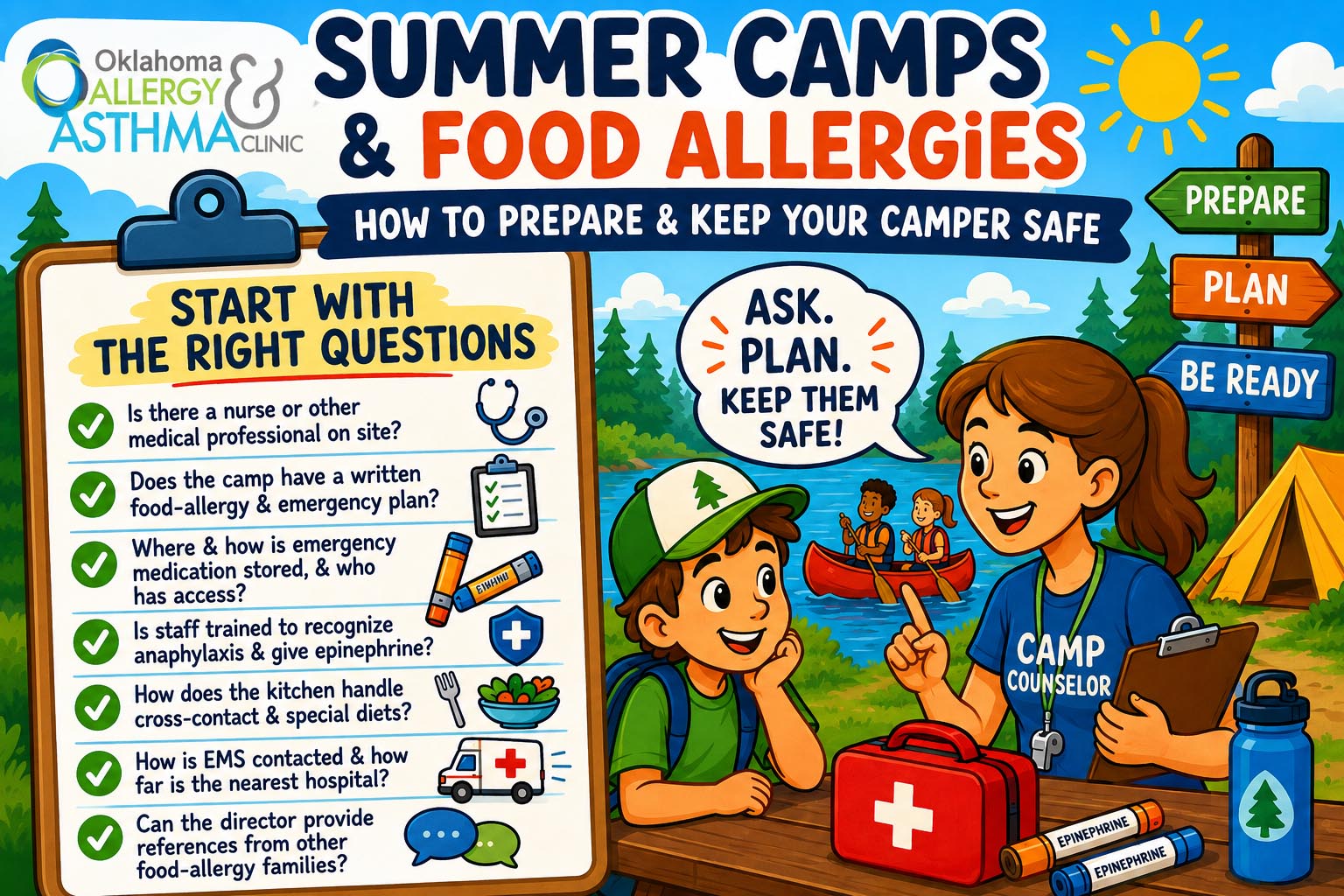
Start with the Right Questions
Before you fall in love with a glossy brochure, get to know the camp itself. The American Camp Association has long advised parents to look past the marketing and evaluate how a camp actually operates — and for a food-allergy family, that means asking specific questions. Talk to the camp director by phone, in writing, and ideally during an in-person visit, and ask:
- Is there a nurse or other medical professional on site? What are their hours and credentials?
- Does the camp have a written food-allergy management plan and an emergency action plan?
- Where and how is emergency medication stored, and who has access to it?
- Is the staff trained to recognize anaphylaxis and to give epinephrine?
- How does the kitchen handle cross-contact, ingredient labels and special diets?
- How does the camp contact EMS, how quickly can a crew arrive, and how far is the nearest hospital? (At rural camps, emergency crews may be volunteers, so response times can be longer.)
- Can the director provide references from other food-allergy families?

“Don’t be shy about asking the camp hard questions – who’s trained, where the medications is kept, how fast EMS can get there. A good camp welcomes those questions. How they answer tells you a lot about whether your child will be safe there,” said Maya Gharfeh, MD, MPH, Oklahoma Allergy & Asthma Clinic
A camp that welcomes these questions — and answers them confidently — is showing you exactly the kind of culture you want.
Put the Paperwork in Place
Documentation is what turns your plan into something the camp can actually follow when you’re not there. Oklahoma Allergy & Asthma Clinic specialists suggest that you prepare:
- A Food Allergy & Anaphylaxis Emergency Care Plan signed by your child’s physician, listing the specific allergens, your child’s typical symptoms, and step-by-step instructions for treating a reaction.
- Written medication instructions and the medications themselves, clearly labeled with your child’s name.
- A recent photo of your child attached to the care plan and the medication kit for quick identification.
- A check of expiration dates on all medications well before drop-off day.
This is also the ideal moment for a pre-camp visit with your allergist to update the action plan, refill medications and confirm your child’s current weight-based dosing.
“Honestly, the best thing a family can do before camp is to come see us. We can update the emergency action plan, make sure the epinephrine isn’t expired, and confirm the dose is right for your child’s current weight,” Gharfeh explained. “A little advance can help prevent a crisis at camp.”
Plan for Mealtimes
Food is at the center of camp life, so it’s worth a specific plan. Here are a few strategies that work well:
- Talk to the camp about having your child go first in the meal line when possible, to lower the risk of cross-contact from shared serving utensils.
- Arrange allergen-aware seating — Talk to the camp about having seating that can help keep your child safe, but in a way that keeps your child with friends rather than isolated. Feeling included matters, and a child who feels singled out is less likely to speak up.
- Reinforce the cardinal rule with your child BEFORE camp – Never trade or share food, and never eat anything with unknown ingredients.
- Clarify the outside-food policy — Before camp, check to see if you are able to provide snacks from home, care packages and canteen purchases that will be safe for your child.
- Send a few safe treats – If allowed, provide some treats to the camp dietary team so that your camper has something special when the group has a snack your child can’t eat.
“It can be challenging, but we want kids with food allergies to be safe and to feel like they belong too,” Gharfeh said. “There’s a way to manage mealtimes – going first in line, sitting in an allergen-aware spot – without making a child feel singled out. A child who feels excluded is also a child who’s less likely to speak up when something’s wrong.”
Keep in mind that the U.S. now recognizes nine major food allergens — milk, egg, peanut, tree nuts, soy, wheat, fish, shellfish and (since 2023) sesame — and that ingredient labels and recipes can change, so please remind the camp that checking every time matters.
Medication and Epinephrine at Camp
Epinephrine is the first-line treatment for anaphylaxis, and quick access can be lifesaving.
“We recommend sending two epinephrine devises to camp because you never want the camp to be caught short,” Gharfeh added. “It is also important to make sure the staff knows exactly where the epinephrine devices are at all times and how to use them.”
Here are a few other potentially life-saving tips:
- Confirm where the devices are stored and who can reach them quickly — including during activities away from the main camp.
- Store epinephrine at room temperature. It can lose potency if it gets too hot or too cold, so it shouldn’t be left in a sweltering cabin, a hot car, or packed directly on ice in a cooler — an especially important point during an Oklahoma summer.
- For off-site trips, ask how the medication and care plan will travel with your camper.
“Please take the time to educate the camp staff that epinephrine is sensitive to temperature,” Gharfeh warned. “It needs to be kept at room temperature so it actually works when it’s needed.”
It’s also worth talking with your allergist about which form of epinephrine is right for your child, she said. In addition to autoinjectors, the FDA approved a needle-free epinephrine nasal spray (neffy) in 2024, with a lower-dose version cleared for smaller children in 2025. For children who fear needles – a common reason treatment gets delayed – it may be an option worth discussing. It’s available by prescription and is weight-based, so your allergist can advise what’s appropriate.”
Teach Your Camper to Self-Advocate
When you’re not there, your child and the camp staff are the front line. Age-appropriate self-management makes a real difference. Teach your camper to:
- Never trade or accept food from others, and to never eat anything with unknown ingredients.
- Read food labels and double-check with a counselor when unsure.
- Speak up at the first sign of a reaction — even a suspected one, and even without visible symptoms.
- Never go off alone if they feel a reaction starting.
- Know where the emergency kit is and which counselors can get to it.
- Know how to use epinephrine, if they’re old enough.
“A child who knows how to self-advocate is far safer at Camp,” Gharfeh said, adding that a medical ID bracelet adds another layer of protection, especially for younger campers.
Don’t Forget Other Summer Triggers
Camp brings more than food into the picture. If your child also has asthma or environmental allergies, send those medications and note them in the care plan. Outdoor activities raise the odds of insect stings, and in Oklahoma, tick bites carry their own concern — including Alpha-gal Syndrome, a tick-triggered allergy to red meat that’s worth knowing about before a week in the woods.
A pre-camp checkup is one of the most valuable things you can do. Your allergist can confirm your child’s diagnosis, update the emergency action plan, make sure medications are current, and help your family head into the summer prepared. If your child has food allergies and camp is on the calendar, schedule a visit with the Oklahoma Allergy & Asthma Clinic — so the only things your camper has to worry about are which activity to pick first.
When to See an Allergist
Stay on top of Oklahoma’s daily pollen and mold levels with the OAAC Pollen and Mold Report.